
Financial Planning Services

Most people don't wake up one morning and decide they need a financial plan.
Usually, there's a question.
Am I doing enough with my super? Could we retire when we want to? Should I be investing more? Are we making the most of the income we’re earning?
If something happened to me, would my family be financially okay?
Or sometimes it’s simply a feeling that, despite working hard and making sensible decisions, everything isn’t quite pulling in the same direction.
That’s where good financial planning can help.
At You First, we believe financial planning should begin by understanding where you are, what matters to you and where you’re trying to go.
Only then can we start working out how your money can help you get there.
Financial Planning Is About More Than Just Money
Superannuation, investments, insurance and retirement planning are all important.
Financial Planning Is About More Than Just Money
Superannuation, investments, insurance and retirement planning are all important.
But they shouldn’t be the starting point. The starting point is your life.
What are you building towards? What responsibilities do you carry? What would you like the next five, ten or twenty years to look like? What would give you greater security, freedom or choice?
We call this your Life Strategy.
Once we understand that, we can begin developing a financial strategy around it — looking at the decisions you can make today to support the life you’re trying to build tomorrow.
Because money is ultimately a tool. The objective isn’t simply to accumulate more of it.
It’s to use it thoughtfully and strategically in support of the things that matter to you.
What Does Estate Planning Include?
Financial planning brings together a number of areas that are often considered separately.
Depending on your circumstances, your financial plan may consider:
Superannuation & Retirement Planning
Investment Strategy & Wealth Creation
Cash Flow & Salary Packaging
Personal Insurance & Income Protection
Debt & Wealth Strategy
Estate & Family Considerations
Making sure your broader financial strategy considers the people you care about and works alongside appropriate estate planning arrangements.
Financial advice is personal.
Not every strategy will be relevant to every person, which is why we start by understanding your circumstances before considering the options available.
How Financial Planning Works at You First
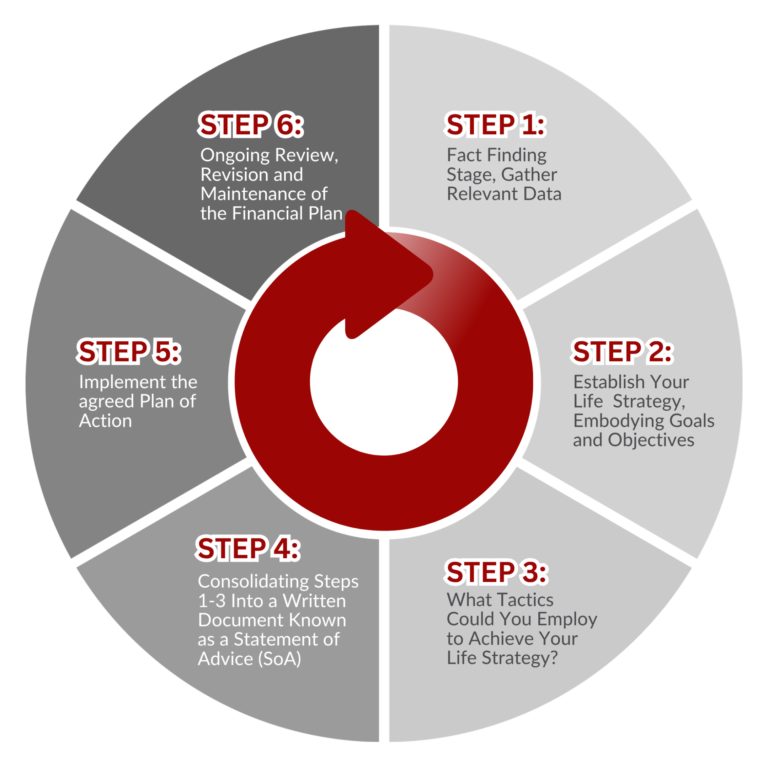
The important part isn’t simply following six steps.
It’s making sure we start with the right destination in mind.
Planning for Retirement —Before Retirement Arrives
The most common question we get asked is “Do I have enough?”
It’s an important question, but retirement planning goes further than arriving at a particular superannuation balance.
There are questions around when you’d like to retire, what you’d like retirement to look like, the income you may need, how your superannuation and other assets fit together, and how your strategy may need to change as retirement gets closer.
For some people, retirement is still decades away. For others, it’s suddenly just over the horizon.
Either way, having a clearer destination can make the decisions along the way easier to understand.
Investments Should Serve the Plan — Not Become the Plan
Investing can play an important role in building wealth over time.
But an investment strategy shouldn’t exist in isolation.
Before deciding where or how to invest, there are broader questions to consider:
What are you investing for?
How long is your timeframe?
How much risk are you comfortable taking?
How does investing fit alongside your mortgage, superannuation, family commitments, tax position and future plans?
That’s why we look at investment strategy as part of the bigger financial picture.
Making More of the Income You're Already Earning
Building your financial future isn't always about earning more.
Sometimes it’s about understanding how to make better use of what is already coming in.
For eligible employees, salary packaging may allow certain expenses or benefits to be structured using pre-tax income. Whether it is appropriate — and what can be packaged — depends on your employer, industry and individual circumstances.
Rather than viewing salary packaging as a standalone benefit, we consider how it fits within your broader cash flow, superannuation and financial strategy.
One Plan. A Bigger Picture.
Financial decisions rarely exist in isolation.
Your mortgage can affect your investment decisions. Your business structure can affect your personal finances. Tax considerations can influence cash flow. Superannuation can interact with retirement and estate planning.
That’s why You First’s One Stop Desk™ brings together financial planning with Tax & Accounting, Mortgages & Lending, Business Advisory and Estate Planning.
It doesn’t mean every client needs every service.
It means that when one financial decision affects another, we’re able to see the connection.
Sometimes the greatest value of financial planning is simply being able to see the wood for the trees.
Financial Planning Is an Ongoing Conversation
A financial plan captures a point in time.
Your life doesn’t.
Families grow. Careers change. Businesses evolve. Children leave home. Parents get older. Retirement that once felt decades away suddenly appears on the horizon.
Some changes are planned. Others arrive without much warning.
Ongoing financial planning gives you an opportunity to revisit the strategy as life changes — understanding what has shifted, what still matters and whether the decisions you’re making are still taking you in the right direction.
It’s not about constantly changing course. It’s about making sure you’re still heading towards the right destination.
FAQs
What does a financial advisor do?
A financial advisor helps you understand your current financial position, establish your goals and consider strategies that may help you work towards them.
Depending on your circumstances, this can include areas such as superannuation, retirement planning, investments, personal insurance, cash flow and wealth creation.
At You First, we begin with your broader Life Strategy so that individual financial decisions can be considered within the context of what you’re actually trying to achieve.
When should I see a financial planner?
You don’t need to wait until retirement or until you have accumulated significant wealth.
People often seek financial advice when something in life is changing — starting a family, buying property, progressing through their career, building a business, receiving an inheritance or beginning to think seriously about retirement.
It can also be useful when you simply feel that your financial decisions have become too complex to manage confidently on your own.
How much does a financial advisor cost?
Can a financial planner help with retirement planning?
Do I need a lot of money before seeing a financial planner?
Not necessarily.
Financial planning is about making informed decisions with the resources you have and considering how those decisions support your future goals. Whether financial advice is appropriate will depend on your circumstances and the questions you need help answering.
Can You First help with superannuation and investments?
Yes. Superannuation and investment strategy can form part of financial planning where appropriate to your circumstances. We consider these areas within your wider financial position rather than viewing them as standalone products.
Do you only work with clients in Brisbane?
A Financial Plan for the Life You're Building
You don’t need to have every answer before speaking with a financial planner. Sometimes the most useful place to begin is with a few bigger questions.
Where am I now? Where do I want to go? And are the financial decisions I’m making actually taking me there?
If you’d like some clarity around your situation, we’re always happy to have a conversation.